List Array ADT
- Summary
- You will implement and test a novel data structure we call a List Array.
- Objectives
-
- Gain exposure to additional semantics for a list ADT
- Practice implementing code to a given specification
- Develop memory management skills
- Reap the benefits of a memory error detector
- Experience using parameterized preprocessor macros
- Reinforce good unit testing habits
Introduction
Typically the list ADT is understood as a linearly indexed data structure supporting get and set operations with an add operation to insert new items at the end of the sequence.
So far we have seen how linked lists can easily support these operations, and clearly arrays can, too. Of course, with arrays, there is the complication that space may run out if the array is not big enough for all the add operations one may want to apply.
One common approach to this problem is to create a new, much larger array when space runs out, copy the old data to this array, and release the previous array. (Java's ArrayList and C++'s vector both use this strategy.) It may seem wasteful at first, but it turns out that the copying time amortizes well if the new array doubles in size.
Unfortunately, that analysis only applies when copying is cheap relative to time spent traversing memory. What if copies are expensive (slow)?
In this assignment, we will take a hybrid approach to expansion by constructing a list which holds arrays of increasingly larger sizes. The (conceptual) concatenation of all the arrays in the list would give rise to the linear index to the data in the collection.
Implementation Details
We will use the following structures to organize the collection's data.
typedef struct node node_t;

struct node {
  data_t * array;
  unsigned int length;
  node_t * next;
};

typedef struct {
  node_t * first;
  unsigned int size;
} listarray_t;
Note that data_t is not part of the C standard. Use of
the code will require we also define this type somewhere before it is
used, as follows.
typedef int data_t;
Of course we need not necessarily
store ints, we could just have
easily have
specified doubles,
chars, or even potentially
a struct
like Picture or a pointer
like float *. (However,
a struct would require us to rethink our approach to the
function contains, which relies on the ==
operator that cannot be used to compare structures.)
In any case, the definitions above give rise to a structure that we can conceptually visualize in the figure below.
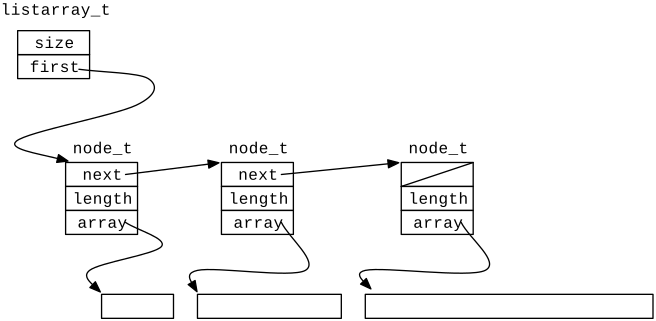
The operations your listarray_t will need to support are
given in the accompanying
listarray.h header and
include new, size, add,
get, set, contains,
and clear.
While your listarray.c implementation will naturally
contain these operations, you can greatly simplify several of them
with an additional helper function that either returns
the address of the data_t item at a
particular index or else returns (via a handle) the
address of the last node_t in the list, (i.e., for when
the index is the list size and the last node's array is
full; this bookkeeping avoids an additional traversal to attach a new
node.)
/* Get pointer to data at specified index
 * Precondition:
 *  index <= size(list) [Note: equality allowed for add() function]
 * Postcondition:
 *  returns address of data item or NULL
 *  if returns NULL and last is not NULL, changes last to point to last node
 * [PRIVATE METHOD] */
data_t *
get_ptr (listarray_t * list, unsigned int index, node_t ** last);
Expansion Behavior
The first node—allocated
when
new (unsigned int capacity)
is called—should contain a array
length capacity, but
the list's size should be zero, because nothing has yet been
added. We put array in quotes because you must use
malloc to create a block of memory with the appropriate
size; the node will then contain a pointer to that block of memory,
which will function as the array in the node.
When the add method is called, the size of
the list should increase and the data item should be stored at the
next available index (as determined by the list size) in the last
node's array.
When there is no such available index (i.e., because the last node's array is full), a new node should be added to the list with an array that is double the size of the previous node's array.
Thus, if the initial capacity is 10, the nodes in the list would have
arrays of lengths 10, 20, 40, 80, etc, as add is invoked to necessitate the
space.
Testing
Because you're implementing an outright data structure, testing is more straightforward. For this assignment, you can use the handy testing macro from the C Preprocessor Lab, as demonstrated the testing program skeleton below.
#include <stdbool.h>
#include <stdio.h>

#include "listarray.h"

#define TEST(EXP,RESULT) if (EXP != RESULT) { ++errors; printf ("  Error for: %s\n", #EXP);}

/* Test collection example */
void
testExample (void)
{
  printf("--EXAMPLE TEST--\n");

  int errors = 0;

  listarray_t * list = new (5);

  TEST( size (list),   0 );   // list is empty
  TEST( add (list,42), true); // added item
  TEST( size (list),   1 );   // list is appropriate size
  TEST( get (list,0),  42);   // check item was added / indexable

  clear(list);
  printf ("Done: errors = %d\n", errors);
} // testExample


/* Test all methods for a single node (no expansions) */
void
testBasic (void)
{
  printf("--BASIC TESTS--\n");

  const unsigned int CAPACITY = 10;
  int errors = 0;

  listarray_t * list = new (CAPACITY);

  TEST( size(list), 0 );        // initial list is empty

  int i; // index for all loops

  /* Test add (successful), size (incremented), and get (new item) */
  for (i=0 ; i<CAPACITY ; i++) {
    TEST( add (list,i), true);  // added item i
    TEST( size (list),  i+1 );  // list is appropriate size
    TEST( get (list,i), i);     // check index i is item i
  }

  /* Test contains (true and false) at all locations*/
  for (i=0 ; i< 2*CAPACITY ; i++) {
    TEST( contains (list,i), i<CAPACITY); // list contains item
  }

  /* Test set (return), size (same), and get (new value) */
  for ( i=0 ; i<CAPACITY ; i++) {
    TEST( set (list, i, i + CAPACITY), i);
    TEST( size (list), CAPACITY ) ;
    TEST( get (list,i), i + CAPACITY);
  }

  clear (list); // should run without memory errors

  printf ("Done: errors = %d\n", errors);
} // testBasic


/* Driver program for test suite */
int
main (void)
{
  testExample();
  testBasic();
  // Add more test collections here
} // main
You should expand this program to include a complete set of tests.
Important Reminders
- Read the documentation carefully to ensure your implementation meets the stated requirements.
-
Every
mallocneeds a correspondingfree; pay attention to error handling even withinnewandadd. -
Be sure to explicitly initialize all fields of a
struct. -
The pattern for allocating a variable of type
foo_tis:
A common mistake is to include thefoo_t * bar = (foo_t *) malloc ( sizeof(foo_t) );*operator in the argument tosizeof. Remember you want enough memory for the actual thing, not just enough memory for a pointer to it. (What you get back is simply a pointer to that amount of space.) - You can get credit for writing correct tests, even if your library doesn't pass.
- You can get credit for correctly implementing operations, even if they rely on other operations that are incorrect in your implementation.
Specific Requirements
-
You must use the
listarray.has provided, without modifications. - Your program and test driver should compile with no warnings (demonstrated in your transcript).
-
Your program and test driver should run cleanly with no
AddressSanitizerreports (demonstrated in your transcript). -
All
malloccalls should be tested for success; failures should be indicated withperrormessages and appropriate return values. -
Whenever possible, preconditions should be
assertion tested. -
You must include a
Makefilewith targets that compile the listarray library and test driver individually into object files, and a target to link them into an executable test program. YourMakefileshould not include debugging symbols or AddressSanitizer by default; these must be requested at compile time through the use of theCFLAGSvariable.
Grading
In addition to the general grading guidelines for evaluation, the assignment is worth 30 points.
-
[20 points]
listarray.cLibrary-
[1 point] Tests
malloccalls for success -
[1 point] Preconditions verified with
assert -
[1 point]
Makefileseparately compiles files and links executable -
[1 point]
Makefileallows additionalCFLAGS -
[16 points] Implementations efficiently meet specification
- [3 points]
get_ptr - [2 points]
new - [1 point]
size - [2 points]
add - [1 point]
get - [2 points]
set - [3 points]
contains - [2 points]
clear
- [3 points]
-
[1 point] Tests
-
Comments on Program Format, Comments, Readability, etc.
(Points not given, but points can be deducted.) -
[10 points] Testing
- [3 points] Test plan enumerates problem circumstances
- [4 points] Test program covers cases, with the expected outcome
- [2 points] Transcript records compilation and AddressSanitized test runs
- [1 points] Summary statement explains why the program is correct
A five point penalty will apply to any submission that includes personally identifying information anywhere other than the references/honesty file.
