Summary: In this lab, you will get some refreshing practice with recursion in Java.
Background
One common operation for scientists (and image analysists) is to count the number of blobs in an image. For instance, say we have a bacterial colony in a petri dish like the left image below.
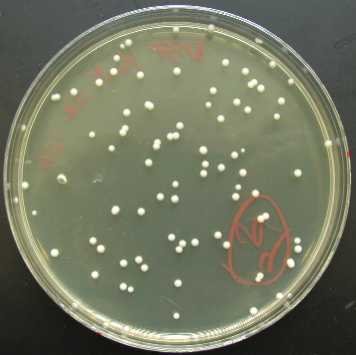
|
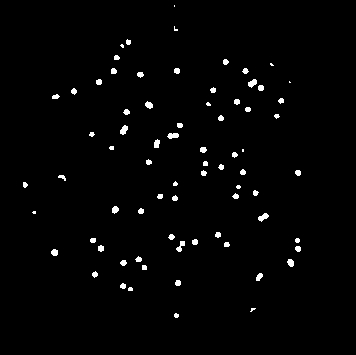
|
| Photo taken by Tami Port, MS, creator of Science Prof Online educational website. |
boolean array.
Preparation
-
Create a directory somewhere for storing the files for this lab.
mkdir somewhere/reclab
-
Go to your new directory
cd somewhere/reclab
-
Copy the files for this lab so that they are modifiable and easily
accessible:
  cp ~weinman/public_html/courses/CSC207/2009S/labs/code/recursion/Grid.java .
  cp ~weinman/public_html/courses/CSC207/2009S/labs/code/recursion/grid.txt .
  cp ~weinman/public_html/courses/CSC207/2009S/labs/code/recursion/bookgrid.txt .
  cp ~weinman/public_html/courses/CSC207/2009S/labs/code/recursion/bacgrid.txt .
Exercises
For the purposes of this lab, we will say that two squares in a grid are connected if they share an edge. Thus, each square has up to four neighbors, the squares directly above and below, and to the right and left. Diagonally adjacent squares are not considered connected neighbors. (Note that boundary squares have even fewer neighbors.) If two occupied squares (the individual white pixels of the image above) of the grid are connected, we say they form a group. Consider the following simple grid.
grid.txt
There is one group of three occupied squares, and one group of an individual occupied square.
0 1 0
1 1 0
0 0 1
Exercise 1
Consider the following grid.
bookgrid.txt
0 0 0 0 0 0 0 0 0 1
0 0 0 1 1 0 0 0 0 1
0 0 0 0 0 0 0 0 0 0
0 0 0 0 1 0 0 1 0 0
0 0 0 1 0 0 0 1 0 0
0 0 0 0 0 0 0 1 1 0
0 0 0 0 0 0 0 0 0 0
0 0 0 0 1 1 0 0 0 0
0 0 0 0 0 0 0 0 0 0
0 0 0 0 0 0 0 0 0 0
- How many groups are there?
- How big is the largest group?
Exercise 2
-
Open
Grid.javaand look it over to see what methods there are. You don't need to understand how they all work, only what they do. -
Compile the class.
javac Grid.java
-
The
Grid.read()method is a factory that takes an input stream and creates aGridobject for you. Verify that this works by running themainmethod already present in the class, which reads a grid from standard input, and outputs the result ofgrid.toString()to the terminal.java Grid < grid.txt
Exercise 3
-
Use recursion to calculate the size of a group (i.e., the number
of connected squares), at a given row and column. That is, you should
complete the implementation of
public int groupSize(int,int) - What is the complexity of your algorithm?
Exercise 4
-
Complete the implementation of
public int getNumGroups - What is the complexity of your algorithm?
Exercise 5
-
Complete the implementation of
public void listGroupsbookgrid.txt, the output should be something like:GROUP: (0,9) (1,9) GROUP: (1,3) (1,4) GROUP: (3,4) GROUP: (3,7) (4,7) (5,7) (5,8) GROUP: (4,3) GROUP: (7,4) (7,5)
where the square locations in a group are given by (row,col) pairs. Note: There are several ways to accomplish this. Like the previous exercise, an appopriate implementation of Exercise 3 will allow you to re-use code with little extra effort! - What is the complexity of your algorithm?