Diodes
Introduction
Once you graduate from the simple, passive components like resistors it's time to step on up to the wonderful world of semiconductors. One of the most widely used semiconductor components is the diode.

In this tutorial we'll cover:
- What is a diode!?
- Theory of diode operation
- Important diode properties
- Different types of diodes
- What diodes look like
- Typical diode applications
Ideal Diodes
The key function of an ideal diode is to control the direction of current-flow. Current passing through a diode can only go in one direction, called the forward direction. Current trying to flow the reverse direction is blocked. They're like the one-way valve of electronics.
If the voltage across a diode is negative, no current can flow*, and the ideal diode looks like an open circuit. In such a situation, the diode is said to be off or reverse biased.
As long as the voltage across the diode isn't negative, it'll "turn on" and conduct current. Ideally* a diode would act like a short circuit (0V across it) if it was conducting current. When a diode is conducting current it's forward biased (electronics jargon for "on").
| Ideal Diode Characteristics | ||
| Operation Mode | On (Forward biased) | Off (Reverse biased) |
|---|---|---|
| Current Through | I>0 | I=0 |
| Voltage Across | V=0 | V<0 |
| Diode looks like | Short circuit | Open circuit |
Circuit Symbol
Every diode has two terminals -- connections on each end of the component -- and those terminals are polarized, meaning the two terminals are distinctly different. It's important not to mix the connections on a diode up. The positive end of a diode is called the anode, and the negative end is called the cathode. (Jerod remembers this because he's not a cat person, so the cathode is negative.) Current can flow from the anode end to the cathode, but not the other direction. If you forget which way current flows through a diode, try to remember the mnemonic ACID: "anode current in diode" (also anode cathode is diode).
The circuit symbol of a standard diode is a triangle butting up against a line. As we'll cover in the later in this tutorial, there are a variety of diode types, but usually their circuit symbol will look something like this:
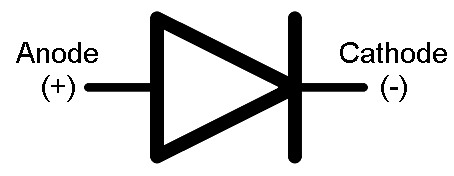
The terminal entering the flat edge of the triangle represents the anode. Current flows in the direction that the triangle/arrow is pointing, but it can't go the other way.
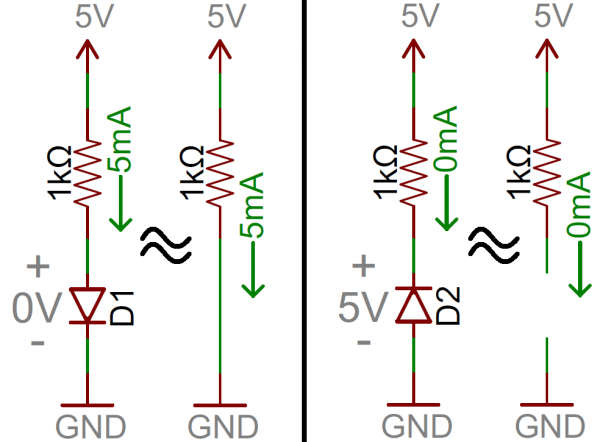
Above are a couple simple diode circuit examples. On the left, diode D1 is forward biased and allowing current to flow through the circuit. In essence it looks like a short circuit. On the right, diode D2 is reverse biased. Current cannot flow through the circuit, and it essentially looks like an open circuit.
*Caveat! Asterisk! Not-entirely-true... Unfortunately, there's no such thing as an ideal diode. But don't worry! Diodes really are real, they've just got a few characteristics which make them operate as a little less than our ideal model...
Real Diode Characteristics
Ideally, diodes will block any and all current flowing the reverse direction, or just act like a short-circuit if current flow is forward. Unfortunately, actual diode behavior isn't quite ideal. Diodes do consume some amount of power when conducting forward current, and they won't block out all reverse current. Real-world diodes are a bit more complicated, and they all have unique characteristics which define how they actually operate.
Current-Voltage Relationship
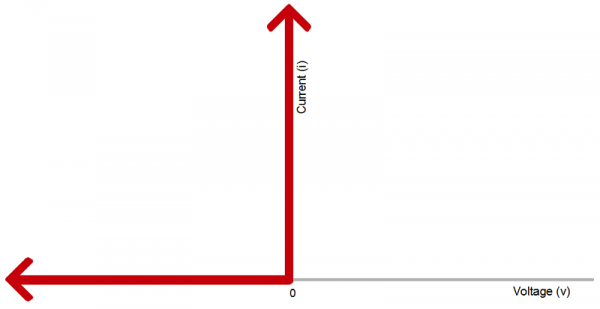
The most important diode characteristic is its current-voltage (i-v) relationship. This defines what the current running through a component is, given what voltage is measured across it. Resistors, for example, have a simple, linear i-v relationship...Ohm's Law. The i-v curve of a diode, though, is entirely non-linear. It looks something like this:
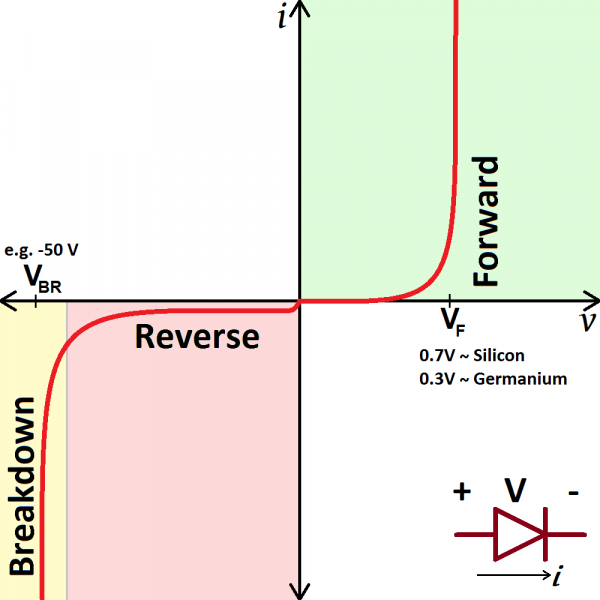
Depending on the voltage applied across it, a diode will operate in one of three regions:
- Forward bias: When the voltage across the diode is positive the diode is "on" and current can run through. The voltage should be greater than the forward voltage (VF) in order for the current to be anything significant.
- Reverse bias: This is the "off" mode of the diode, where the voltage is less than VF but greater than -VBR. In this mode current flow is (mostly) blocked, and the diode is off. A very small amount of current (on the order of nA) -- called reverse saturation current -- is able to flow in reverse through the diode.
- Breakdown: When the voltage applied across the diode is very large and negative, lots of current will be able to flow in the reverse direction, from cathode to anode.
Forward Voltage
In order to "turn on" and conduct current in the forward direction, a diode requires a certain amount of positive voltage to be applied across it. The typical voltage required to turn the diode on is called the forward voltage (VF). It might also be called either the cut-in voltage or on-voltage.
As we know from the I-V curve, the current through and voltage across a diode are interdependent. More current means more voltage, less voltage means less current. Once the voltage gets to about the forward voltage rating, though, large increases in current should still only mean a very small increase in voltage. If a diode is fully conducting, it can usually be assumed that the voltage across it is the forward voltage rating.
A specific diode's VF depends on what semiconductor material it's made out of. Typically, a silicon diode will have a VF around 0.6–1V. A germanium-based diode might be lower, around 0.3V. The type of diode also has some importance in defining the forward voltage drop; light-emitting diodes can have a much larger VF, while Schottky diodes are designed specifically to have a much lower-than-usual forward voltage.
Breakdown Voltage
If a large enough negative voltage is applied to the diode, it will give in and allow current to flow in the reverse direction. This large negative voltage is called the breakdown voltage. Some diodes are actually designed to operate in the breakdown region, but for most normal diodes it's not very healthy for them to be subjected to large negative voltages.
For normal diodes this breakdown voltage is around -50V to -100V, or even more negative.
Diode Datasheets
All of the above characteristics should be detailed in the datasheet for every diode.
The datasheet also likely points out another important diode characteristic -- the maximum forward current. Just like any component, diodes can only dissipate so much power before they blow. All diodes should list maximum current, reverse voltage, and power dissipation. If a diode is subject to more voltage or current than it can handle, expect it to heat up (or worse; melt, smoke,...).
Types of Diodes
There are a huge variety of diodes for various applications, and we won't need to outline all of them here.
Standard signal diodes are among the most basic, average, no-frills members of the diode family. They usually have a medium-high forward voltage drop and a low maximum current rating.
A rectifier or power diode is a standard diode with a much higher maximum current rating. This higher current rating usually comes at the cost of a larger forward voltage.
Light-Emitting Diodes (LEDs!)
The flashiest member of the diode family must be the light-emitting diode (LED). These diodes quite literally light up when a positive voltage is applied.
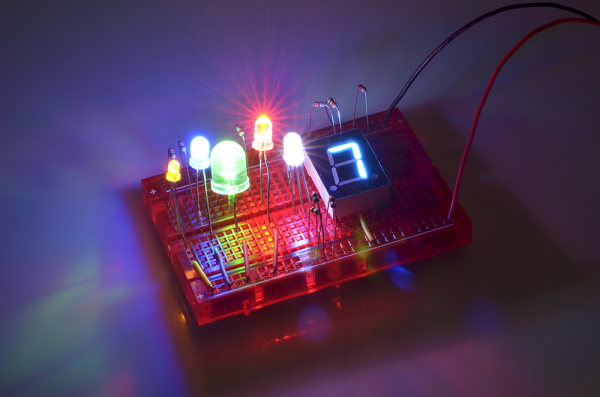
Like normal diodes, LEDs only allow current through one direction. They also have a forward voltage rating, which is the voltage required for them to light up. The VF rating of an LED is usually larger than that of a normal diode (1.2~3V), and it depends on the color the LED emits. For example, the rated forward voltage of a Super Bright Blue LED is around 3.3V, while that of the equal size Super Bright Red LED is only 2.2V.
You'll obviously most-often find LEDs in lighting applications. They're blinky and fun! But more than that, their high-efficiency has lead to widespread use in street lights, displays, backlighting, and much more. Other LEDs emit a light that is not visible to the human eye, like infrared LEDs, which are the backbone of most remote controls.
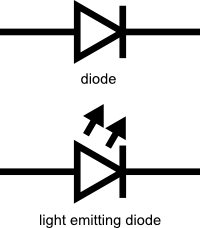
Note how the schematic symbol for the diode varies from the normal diode. LED symbols add a couple arrows extending out from the symbol.