Lab/Assignment Submission Guidelines
CSC 211 - Computer Organization and Architecture - Weinman
- Summary:
- We provide details on the policies for submitting course work.
Contents
english 1 Collaboration2 Grading
2.1 Logic Circuits
2.1.1 Wire Layout
2.1.2 Gate Layout
2.1.3 Logic Design
2.2 Assembly Programs
2.2.1 Code Format
2.2.2 Code Comments
2.2.3 Code Documentation
3 Header
4 References and Academic Honesty Certification
5 Format
6 Submission
1 Collaboration
When an assignment is to be completed individually, you must respect the course academic honesty policy. When you work on lab assignments with a randomly assigned partner; labs must be completed and submitted with these assigned partners. Working with a partner will help ensure you can take some advantage of the principle that "Given enough eyeballs, all bugs are shallow."1 Working with an assigned partner will increase the chances of being exposed to different ways of thinking and problem solving as well as help you practice the skills you'll need in the work world, where you do not typically get to choose your coworkers. Everyone whose name appears on a submitted group lab report has the responsibility to ensure everyone fully understands the submission. Other discussions must respect the course academic honesty policy.2 Grading
In addition to assessing the objective correctness of your work, several important stylistic considerations will be important.2.1 Logic Circuits
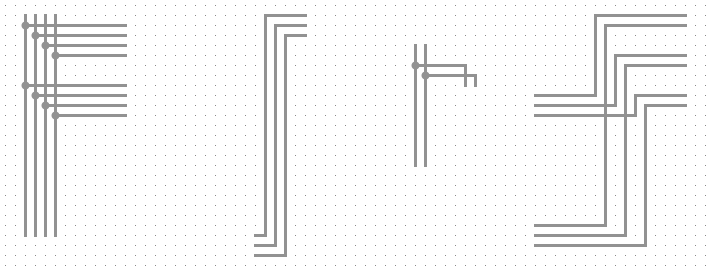
2.1.1 Wire Layout
- Wires avoid crossing when possible
- Wires for analogous signals use parallel, mirrored, or other similar form
- Wires are generally clean and well-organized (i.e., no unnecessary solders or bending)
2.1.2 Gate Layout
- Analogous gates align appropriately
- Gates have no unused inputs
- Gate size is appropriate for circuit diagram
- Circuit orientation (flow) is generally left-to-right
- Gate orientation facilitates comprehension and good wire layout
- I/O pin placement facilitates organization and wire layout
2.1.3 Logic Design
- Components use an appropriate level of abstraction
- Uses minimal/simplest logic blocks
2.2 Assembly Programs
2.2.1 Code Format
- Labels left align (are unindented)
- Uses clear, meaningful label names
- Instructions uniformly indented
- Instructions' first arguments align
- Comments align
2.2.2 Code Comments
- Each instruction (or short block) is commented
- Comments clearly and concisely describe the purpose of instructions
2.2.3 Code Documentation
- Procedures document purpose/description
- Procedures document arguments
- Procedures document return value(s)
3 Header
You would be surprised how often the wrong files are submitted; a common header makes it easier for everyone to quickly identify. The very beginning of each and every project file (including references) should contain the identifying line.- Lab: Title
4 References and Academic Honesty Certification
Each and every submission must include a single file, references.txt, with the following information (sources, help, certification) completed.- Lab: Title Academic honesty certification: Written/online sources used: [include textbook(s), CSC 211 labs or readings; use complete citations for Web or other written sources; write none if no sources used] Help obtained [indicate names of instructor, class mentor or others, in accordance with class policy; write none if none of these sources used] Our initials below confirm that the above list of sources is complete AND that I/we have not talked to anyone else (e.g., CSC 211 students) about the solution to this problem Initials: ABC, DEF
5 Format
All textual submission content must be in plain text files (note: source code is a text file), rather than special word processing or other document formats (e.g., .doc, .docx, .odp, .pdf). Logisim circuits will be submitted in files using its native .circ extension. MIPS assembly files will be submitted with the .asm extension.- References
- To facilitate blind grading, references and academic honesty must be included in a separate file, not included within any program files.
- Content
- A complete program should usually be given as a single entity (file), unless otherwise specified in the instructions. Multiple programs or Logisim circuits would be submitted in separate files, as directed.
6 Submission
Submit your files to the corresponding assignment on Gradescope by the deadline. Attach each file containing your answers (cf. 5) to upload. Only one submission per project group is required; make sure the person submitting indicates the other member(s) of the team submission. However, all group members are jointly responsible for ensuring a submission is made. For example, if your partner told you they would submit the project but forgets to do so, all group members will be held responsible. For this reason, I strongly recommend submitting work while you are sitting together. Note that Gradescope tracks the submission time to the second (but only shows the hour and minute); thus if your submission is flagged as late, it is because it was indeed submitted after the deadline (measured in seconds). Thus you will want to ensure you allow yourself enough time to make your submission correctly, completely, and punctually.Acknowledgments
This is a derivative work of Detailed Coursework Instructions by Henry Walker; used under a CC-BY-NC-SA 4.0 license.Copyright © 2015 Jerod
Weinman.

This work is licensed under a Creative
Commons Attribution-Noncommercial-Share Alike 4.0 International License.