Goals: This laboratory exercise provides practice with shared memory and process synchronization in Linux, focusing on the Bounded Buffer problem.
Collaboration: You will complete this lab in teams as assigned by the instructor. You may, as always, consult with your classmates on issues of design and debugging.
sleep statement from the child process,
rerun bounded-buffer-1.c, and explain the output
produced.
sleep statement to the
child process, and remove it from the parent process. Again,
rerun bounded-buffer-1.c, and explain the output
produced.
sleep statements to synchronize
the two processes, consider the use of busy-waiting. In this
approach, when the value stored in shared memory is -1, then the
parent is allowed to write the next value. When the value is
not -1, the child will read it.
sleep statement for the parent, adding
a while statement that waits until the shared memory contains
the value -1. When this condition occurs, the parent may write
the next square into the shared memory. At the end of the
parent's loop, the value in shared memory should be set to a
value other than -1. (Why?)
sleep statement for the child, adding a
while statement that waits until the shared memory does not contain
the value -1. When this condition occurs, the child may read the
next square from the shared memory. At the end of the child's
loop, the value in shared memory should be reset to -1. (Why?)
bounded-buffer-2.c will work when there
are multiple readers or when there are multiple writers. In each case,
if the code would work, explain why. If the code would not work, give
a timing sequence involving the several readers and/or writers showing
what would go wrong.
bounded-buffer-3.c
to your account. Compile it, run it a few times, and review it to
be sure you understand how it works.
bounded-buffer-3.c, in place of the busy-waits in
Step 4 to handle the synchronization of the reader and the writer
process from bounded-buffer-1.c. Your final program
should neither busy-wait nor use sleep
statements.
bounded-buffer-4.c
to your account, compile it, and run it.
mutex.
Explain the purpose of this semaphore. Specifically, if
the mutex semaphore were omitted, give a timing
sequence involving the several readers and/or writers should what
might go
wrong.
bounded-buffer-4.c prevents any reader from
working at the same time as any writer. Assuming that the buffer
contains several locations, however, writing to one buffer
location should not interfere with reading from
another. That is, the critical section for readers is not
the same as the critical section for writers. Remove
the mutex semaphore and add additional semaphores, as
needed, so that some reader could work concurrently with some
writer (assuming the buffer was neither empty nor completely
full---so that both reading and writing make
sense.)
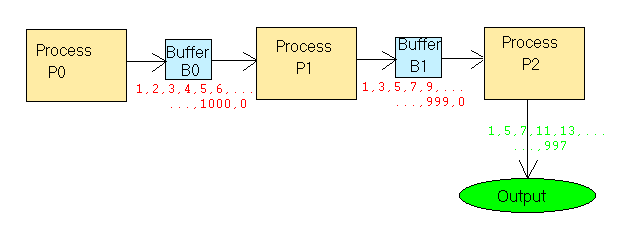
Consider the following problem. A program is to be written to print all numbers between 1 and 1000 (inclusive) that are not (evenly) divisible by either 2 or 3.
The problem is to be solved using three processes (P0, P1, P2) and two one-integer buffers (B0 and B1) as follows: