Goals: This laboratory exercise provides practice with the use of pipes to allow interprocess communication, and the strategy of problem solving by connecting small, specialized programs.
Preparation:Read through sample programs fork-2.c through fork-6.c in An Introduction to Concurrency in Unix-based [GNU] C Through Annotated Examples .
Collaboration: You will complete this lab in teams of 1 to 3 of your choice. You may, as always, consult with your classmates on issues of design and debugging.
pipeNote: It is expected that the written answers you give will be short.
In the statement write (fd[1], ...) change the 23 to 10. Then recompile and rerun. How does this affect the running of the program? Briefly explain what you see.
Now change the 10 (formerly 23) to 30 and rerun. Again, describe the effect and explain why this happens.
read (fd[0], line, MAX);
printf ("The string received is '%s'\n",line);
read(fd[0], line, MAX);
printf ("The string received is '%s'\n", line);
That is, perform the reading and printing twice. Rerun the
program. Describe and explain the
result.
write (fd[1], "ABCDEFGHIJKLMNOPQRSTUVWXYZ", 26);
write (fd[1], "abcdefghijklmnopqrstuvwxyz", 26);
Rerun the program. Describe and explain the result.
Consider the following problem, which is based on an exercise by John Stone:
The file Iowa-cities.dat contains information about the sixty largest cities and towns in Iowa: their names and populations, as determined by the 2000, 1990, and 1980 censuses. A typical line of the file looks like this:
Grinnell,9105,8902,8868There are 4 fields separated by commas. Field 1 is the name of the town (at most 16 characters); field 2 contains the 2000 population;
In this part of the lab, you are to write a C program which reads data from this file and determines the answers to the following two questions:
The basic approach for this problem is illustrated in the following diagram:
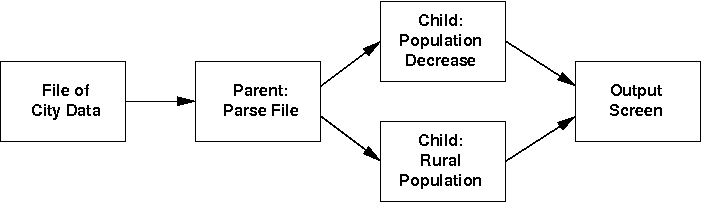
As this diagram suggests, one parent process will spawn two children; the parent and both children then should collaborate to perform this work. Overall, the parent process will read the file and send some data from each line through a pipe to both children. Each child will answer one of the above questions. More precisely: